
By Jones Anlimah
The Volta Regional Minister, Hon. James Gunu, has reiterated government’s resolve to accelerate development across critical sectors in the region including infrastructure, security, agriculture, education, health, and job creation.
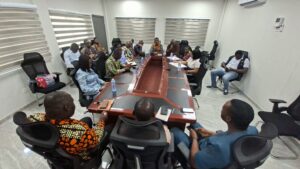
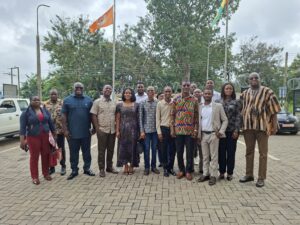
Addressing the final meeting of the Volta Regional Coordinating Council (VRCC) in Ho, Mr. Gunu commended stakeholders for their efforts in maintaining peace and fostering inclusive development throughout 2025.
“This year, the National Democratic Congress government, under the distinguished leadership of His Excellency President John Dramani Mahama, allocated a ₵1 billion retooling package to strengthen our security agencies,” Mr. Gunu said. “While these funds are not region-specific, the Volta Region continues to benefit through enhanced policing, intelligence, border security, and emergency response.”
He noted that the region remains generally peaceful despite isolated disputes.
“The peace and stability of the Volta Region is non-negotiable,” he stressed. “Security is a shared responsibility requiring collaboration among chiefs, MMDCEs, security services, youth, and community leaders.”
Infrastructure and Roads
On road infrastructure, Mr. Gunu announced that several major projects are underway across the region.
“Contractors have mobilised resources, established site camps, and begun work,” he said. “We are optimistic that many of these projects will reach substantial completion soon, and we hope to have a road commissioned by His Excellency the President next year, God willing.”
He cited key projects such as the Ho–Titrinu–Airport Gate road, the Atimpoku–Asikuma–Junction road among others.
“These roads,” he explained, “will improve transportation, enhance trade, reduce travel time, and strengthen connectivity across the region, boosting overall economic activity.”
Water and Sanitation
Turning to water and sanitation, the Minister emphasised that access to clean water is both a moral and developmental imperative.
“Access to clean water and proper sanitation is not merely a service, it is a fundamental human right essential for health, education, and productivity,” he said.
He highlighted the Adidome Water Treatment Plant Project, noting that phases one and two have been completed, while efforts are ongoing to resume phase three to extend pipelines to Ho and surrounding towns.
“Our determination to achieve universal access to clean and safe drinking water is unwavering,” he declared. “The Water for All initiative remains a bold and transformative intervention that will guarantee equitable access across the Volta Region.”
Agriculture and Economic Growth
In the agricultural sector, Mr. Gunu said government had allocated ₵1.5 billion under the Feed Ghana Programme to modernise farming through irrigation, mechanisation, and value addition.
“The Volta Region is well positioned to benefit from international market opportunities, including new U.S. tariff exemptions for Ghanaian agricultural exports,” he said, encouraging farmers to explore export markets.
He also mentioned local initiatives such as the Youth in Agriculture and Kukukiti-Kiti poultry programmes, which aim to create employment and ensure food security.
“We are encouraging year-round farming supported by renewable energy technologies such as solar-powered irrigation systems,” Mr. Gunu explained. “Our goal is to make agriculture both profitable and sustainable for our youth.”
On the economy, he celebrated the success of the Volta Trade and Investment Fair and the Volta Economic Forum, describing them as strategic platforms that position the region for inclusive, investment-led growth.
“These initiatives reflect a coherent strategy to open our region for business, stimulate inclusive development, and unlock economic potential,” he noted. “With continued collaboration, we will build a stronger, more competitive, and prosperous Volta Region.”
He announced that land had been secured for the Aflao Development Project, which will establish a 24-hour cross-border economic market to enhance trade and create new jobs for women and youth.
Education and Skills Development
Education featured prominently in the Minister’s address.
“At the regional level, government’s educational initiatives have translated into tangible benefits,” he said. “Under the Free SHS programme, 34,026 junior high graduates were admitted into 68 senior high and technical schools across the region.”
He further revealed that over 32,000 digital learning tablets had been distributed to teachers and students, and more than 467,000 sanitary pads were supplied to schoolgirls to promote menstrual hygiene and reduce absenteeism.
“No girl should miss school because she lacks sanitary products,” Mr. Gunu stated. “We are committed to ensuring every child, regardless of background, has equal opportunity to learn.”
He disclosed that 278 educational infrastructure projects were ongoing under GETFund, covering classroom blocks, dormitories, science laboratories, and staff accommodation.
Health and Social Development
On health, Mr. Gunu provided updates on the Agenda 111 district hospital projects, noting that although some sites had stalled, plans were underway to resume work.
“When completed, these facilities will expand access to quality health care, strengthen emergency services, and improve referral systems,” he explained.
He announced that all hospitals in the region had benefited from upgrades under the Maternal and Child Health Improvement Programme, including the provision of new delivery beds, incubators, and neonatal care equipment.
“These investments are already reducing maternal and newborn complications and improving survival outcomes,” he said.
He also reported a strong performance in the HPV vaccination campaign, saying:
“Out of 150,000 targeted girls aged 9 to 14, a total of 93,871 have been vaccinated — an impressive coverage rate of 81.6 percent.”
Youth Employment and Skills Training
The Minister revealed that the Youth Employment Agency (YEA) engaged 3,331 young people under various government programmes, while the National Apprenticeship Programme provided structured training to 2,060 apprentices under 412 master craftspersons.
“These interventions are strengthening youth empowerment, technical and vocational skills, and sustainable employment,” he said. “Through initiatives like the Oxygen City Project, we are creating jobs and preparing our youth for the modern economy.”
Mr. Gunu concluded by reaffirming the VRCC’s commitment to President John Dramani Mahama’s “Resetting Agenda”, aimed at promoting peace, sustainable development, and improved service delivery.
“The task before us is to build on our achievements and translate them into lasting impact,” he urged. “Together, we will build a brighter future for the Volta Region, a future defined by innovation, opportunity, and shared prosperity.”
He ended with festive wishes to participants. “I wish you all a Merry Christmas and a prosperous New Year. Long live the Volta Region, and long live Ghana.”